






 Trap
 Normal
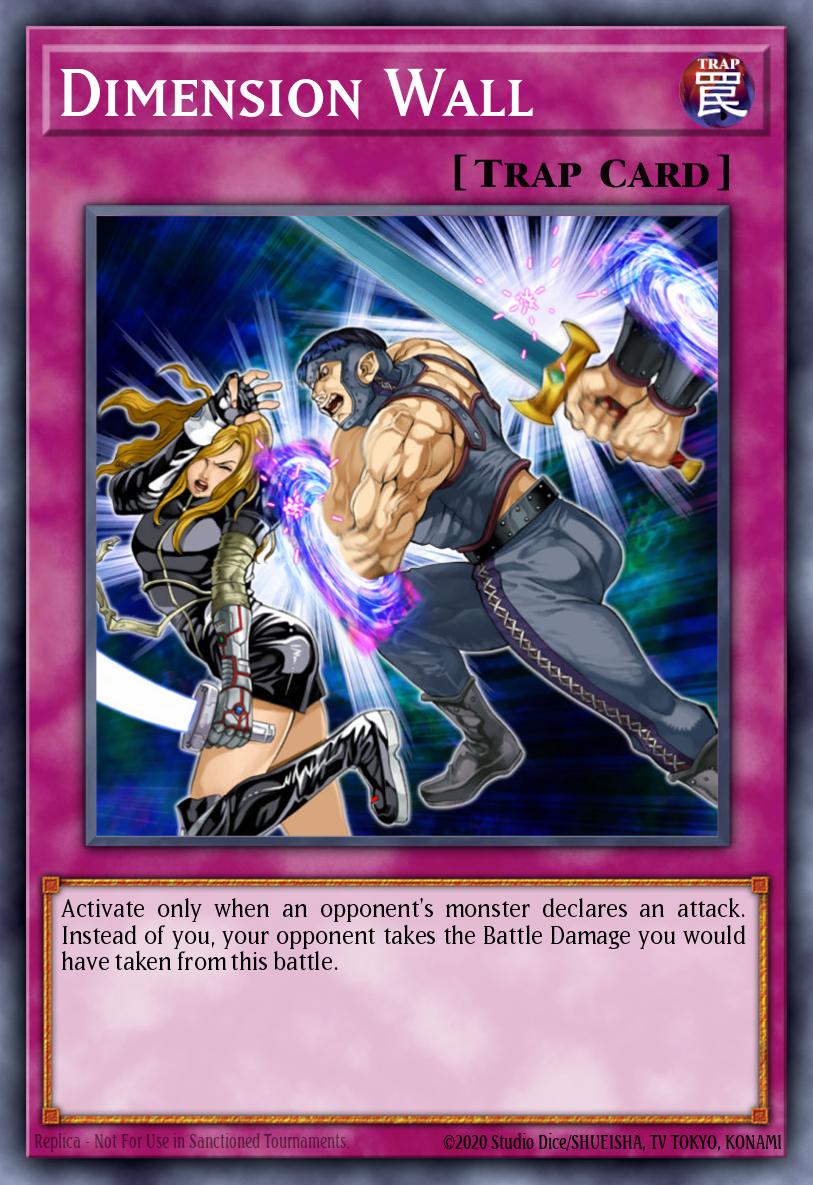
Dimension Wall
View:
6139
Activate only when an opponent's monster declares an attack. Instead of you, your opponent takes the Battle Damage you would have taken from this battle.
Dimension Wall — Power Evaluation
Final Score: 49 ± 8 · Confidence: Medium
- Intrinsic: 50 · Deck: 49 · Meta: provisional
- Primary role: Utility · Secondary: Negation/Interaction
Why it scores here
Dimension Wall is a generic Normal Trap that redirects one battle-damage instance to the opponent. Its value is a situational, soft defensive effect: it converts a set trap into a damage swing during an attack but adds no board, no card advantage, and no material value. It is cheap and easy to run across 85 archetypes, which earns deckbuilding and portability points, but the 327-deck sample reflects its generic staple status and does not raise the score on its own (guardrail 3). Its 1-appearance combo sample shows nothing about the card's own contribution.
Axis scores
| Axis | Score | Evidence |
|---|---|---|
| Accessibility | 70 | Appears in 327 recent decks at an average of 2.32 copies, and it is a set trap that can be drawn normally. The combo evidence shows zero starter or searcher roles, so there is no search route. (observed) |
| Combo & Conversion | 15 | The card has one combo appearance, as a non-starter, non-searched, non-payoff piece, and the high power index of that board belongs to the Altergeist board rather than to this card. It builds nothing on its own. (observed) |
| Resource Economy | 30 | Redirecting battle damage prevents loss of life but gives no card advantage, refuel, or recursion. The evidence has no net-advantage attribution for this card. (inferred) |
| Effect & Interaction | 50 | It is a situational battle-damage redirect that only works when an opponent's monster attacks. It is soft interaction and not a negation or removal. (verified) |
| Material Utility | 5 | Its race is Normal and it is a trap card, so it cannot be used as material and does not convert into any body when negated. (verified) |
| Resilience & Flexibility | 40 | As a face-down trap it is exposed to trap negation and trap destruction, and it has a single, timing-dependent use. Spread across many archetypes it has some redundancy. (inferred) |
| Deck-Building Efficiency | 80 | It is a generic trap with no garnet, lock, or brick restriction, and extra copies are harmless, so it is nearly free to run. (verified) |
Calculation
Weight profile: Utility default weights (no clear primary role; Negation/Interaction noted as secondary, not blended). Intrinsic ≈ 50, Deck ≈ 49, Meta = provisional. Modifiers: none. Final formula: 0.40*Intrinsic + 0.60*Deck
Strengths
- Cheap, non-garnet trap that runs in almost any deck
- Stops one attacking monster's battle damage at the cost of a single set trap
- Broad portability: 85 distinct archetypes in the sample
Weaknesses
- Does nothing without an opposing attack
- No card advantage, search, or material value
- Only reduces damage on the turn it is used; it does not stop the attacker or the monster
Counters / choke points
- Trap negation and trap destruction effects (generic, inferred; no specific card named in the evidence)
Best use
Generic defensive trap slot in decks that expect attacks; most useful in Chain Burn, Timelord, and Greed lists per the deck sample. Suggested copies: 2.
Evidence & gaps
- Verified: Text: activates only when an opponent's monster declares an attack and redirects one battle-damage instance to the opponent; Race Normal, trap card, no ATK/DEF or link stats; Deck sample: 327 decks, 2.32 average copies, 85 distinct archetypes
- Observed: Appears in 100% of the single combo sample but with no starter, searched, material, or payoff role; Average power index 82 comes from a board where this card is not the driver
- Inferred: Soft, situational interaction with real value only on the turn of an attack; Vulnerable to trap negation and destruction
- Data gaps: No banlist token; assumed 3 copies (unlimited) No usage statistics (StatisticsCard) for inclusion % across archetypes Only one combo appearance, so combo centrality cannot be measured No rulings or FAQ evidence supplied